For most trade businesses the answer is to have both, but they do different jobs. A trade directory rents you a place where customers are already comparing firms. A website is a place that belongs to you. Which one is worth your money depends on how full your diary is and how long you plan to trade.
What a directory gives you
A directory has an audience before you arrive. Homeowners go there to find a roofer, a plumber or an electrician, and your profile appears in the list. For a new firm with no reputation, that is a quick way to get the phone ringing.
Most directories also give you a trust signal. Customers see a vetted badge, a review score and a record of past jobs gathered in one place. A homeowner who has never heard of you may accept that more readily than a claim on your own page.
Those are real advantages, and they are the reason directories are worth considering in the first year of a business.
What you give up
The costs are less visible. You pay every month, and when you stop, the profile and the leads stop with it. Nothing you built up belongs to you.
The layout is also fixed. Your profile sits in a list of competitors, often with the same headline, the same badge and the same star rating. A customer deciding between six firms on one page looks at price and distance, because little else differs.
Leads from a directory are often sent to more than one firm. If a customer asks for three quotes, you may be one of three people ringing them. Winning that job means being the cheapest or the first to answer, and neither is a good basis for a business.
Directory fees vary by trade, area and plan, and they change. Check the current figures on the directory's own pricing page, then compare them with what you take on from it.

What your own website gives you
A website works like an asset, not a subscription to someone else's audience. It is the one place where a customer sees only your work, your reviews and your phone number, with no other firm in the next row.
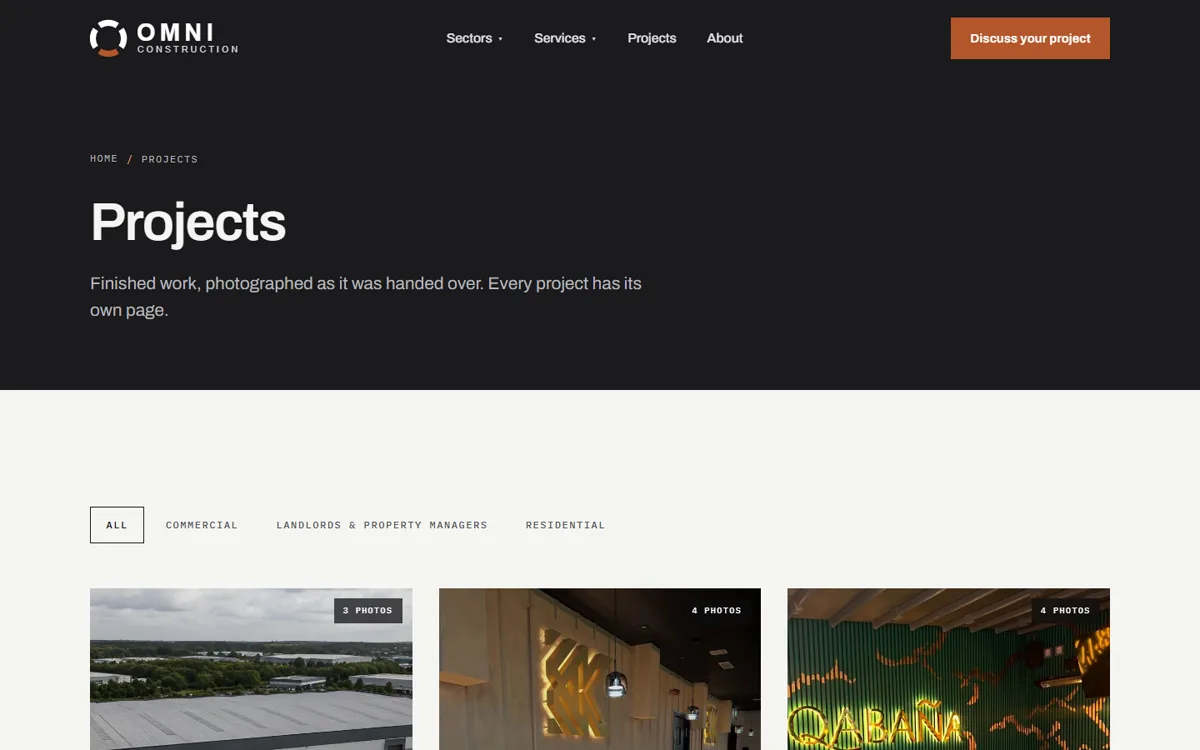
You choose how it looks and what it says. You can give each service its own page, show a gallery for each type of job and list the towns you cover. We built Lumina Designed this way, with a portfolio the visitor can filter by commercial or residential work, so each customer lands on jobs like theirs.
Enquiries that arrive through your site come to you alone. The customer chose your page, not a list, and that usually makes the first call easier.
The weakness is that a new website has no audience of its own. It needs time and some effort before Google shows it. Directories win the first month and sites win the third year.
Where customers actually look first
It helps to know where homeowners start. BrightLocal's Consumer Search Behavior research for 2025 found that 45% of consumers default to Google for local searches and a further 15% start in Google Maps. The survey asked 1,000 US adults, so it describes American habits, and we have no UK figure that measures the same thing.
The same company's Local Consumer Review Survey 2026 found that 71% of consumers use Google to read reviews for local businesses, and that the average consumer uses six different review sites when choosing a firm. Those 1,002 US adults spread their attention across several places.
Two points follow for a tradesman. Google is where the search often starts, so your own Google Business Profile and website are what appear first for your name. A directory profile is only one of the places a careful customer will look, so it cannot be the only one you control.
When the directory is the right call
A directory suits you best when:
- You have just started and need work in the first few months
- Your diary is empty and a monthly fee is easier to find than a lump sum
- You work in a trade where customers rarely search for a firm by name
- You can answer a lead within minutes, every time
In those cases, pay for it, but treat it as a short-term tool and track what it brings in.
When your own site matters more
A website matters more when you already get work by referral, because every referred customer checks you online before ringing. It also matters when you want to charge on quality, because on a directory the customer compares prices first. And it matters when you plan to be in business in five years, because a site gets stronger as it ages and a subscription stays the same.
Our post on whether tradesmen need a website if work comes by referral covers the first case in more detail.
How to work out if the directory pays for itself
You do not need a spreadsheet. Do this once a quarter:
- Add up what you paid the directory over the last twelve months.
- List the jobs you won from it, and the profit on each.
- Subtract the fees from the profit.
If the answer is clearly positive, keep paying. If you cannot say which jobs came from it, start asking every new customer where they found you. Write the answer down on the quote sheet, because memory is poor at this.
Using both
The best set-up for many firms is both, with the website as the centre. Link your directory profile to your site. Put the same photographs and the same reviews in both places. Then, when a customer from the directory wants to know more, they land on a page where you are the only firm.
Over time you can see which brings the better work. If the website wins, you can reduce the directory plan and keep the money.
How SiteFlash fits in
We build websites for UK trade businesses, so you can own the place where customers end up. Our two packages start at 149 pounds a month with no upfront cost and no contract, and you see a working concept of your site before you pay. Hosting, your domain and edits are included. If you keep a directory profile alongside it, we are happy to see you do that.