A website builder suits a trade business when you have the time to write, photograph and update the site yourself. A web designer suits you when your evenings are already spoken for and you want the site to bring in work without you looking after it. Picking a website builder for tradesmen or paying a designer comes down to which costs you less: the monthly fee, or the hours you put in.
How many trade firms have a site at all
Construction lags behind most sectors online. The government's UK Business Data Survey 2026, published by the Department for Science, Innovation and Technology in June 2026, found that 78% of UK businesses said they have a website. For firms in the construction sector the figure was 65%.
That gap is an opening. Roughly one construction firm in three in that survey said it has no website at all. Whichever route you take, having a decent site already puts you ahead of a share of the firms you quote against.
What a website builder gives you
A builder is a service where you pick a template, drag in your text and photos, and publish. You pay a monthly fee to the platform, and it hosts the site for you.
The good parts are real. You can start tonight. The templates already work on a phone. The monthly cost is low, and you can change a phone number or add a photo of last week's job whenever you like.
For a sole trader who is new, with a short list of services and one town, that can be all you need. A plasterer in Doncaster with five jobs a month from referrals mostly needs a page that confirms the business exists, shows some finished ceilings and gives the number.
What a builder costs you in time
The fee is the small part. The template is quick to choose. Everything after that is your work.
A first version means writing a paragraph for every service, picking photographs that are sharp and well lit, buying a domain and connecting it, and setting up a contact form that sends to the right inbox. Then you check every page on your own phone, because that is where most customers will see it.
After launch, a site needs looking after. New jobs go in the gallery. A new service needs a page. A form can stop sending without warning, and you only find out when a customer rings to ask why nobody replied. If you finish on site at six and do quotes after tea, that work tends to slip, and a site last touched two years ago tells a visitor something too.
The same survey asked how businesses with a website manage it. 27% said they manage it entirely in-house, 17% manage it in-house using a platform provider, 29% use a mix of in-house and outside help, and 24% leave it entirely to an external web developer or platform, according to the UK Business Data Survey 2026. The survey also found sole traders were more likely to run their site entirely themselves. Plenty of owners make DIY work. Many others hand at least part of it over.
Where a builder starts to hold you back
Most builders can do far more than a one-page site. The limit is usually the time and know-how to set it up, more than the software.
The first sign is search. A customer in Rotherham types "flat roof repair Rotherham", and Google tends to favour a page about flat roof repairs that mentions Rotherham. A single page listing everything you do is weaker for that search. To compete, you need a page for each main service and often for each main town, with its own title and description. Our guide to local SEO for trade businesses explains how those pages work with your Google profile.
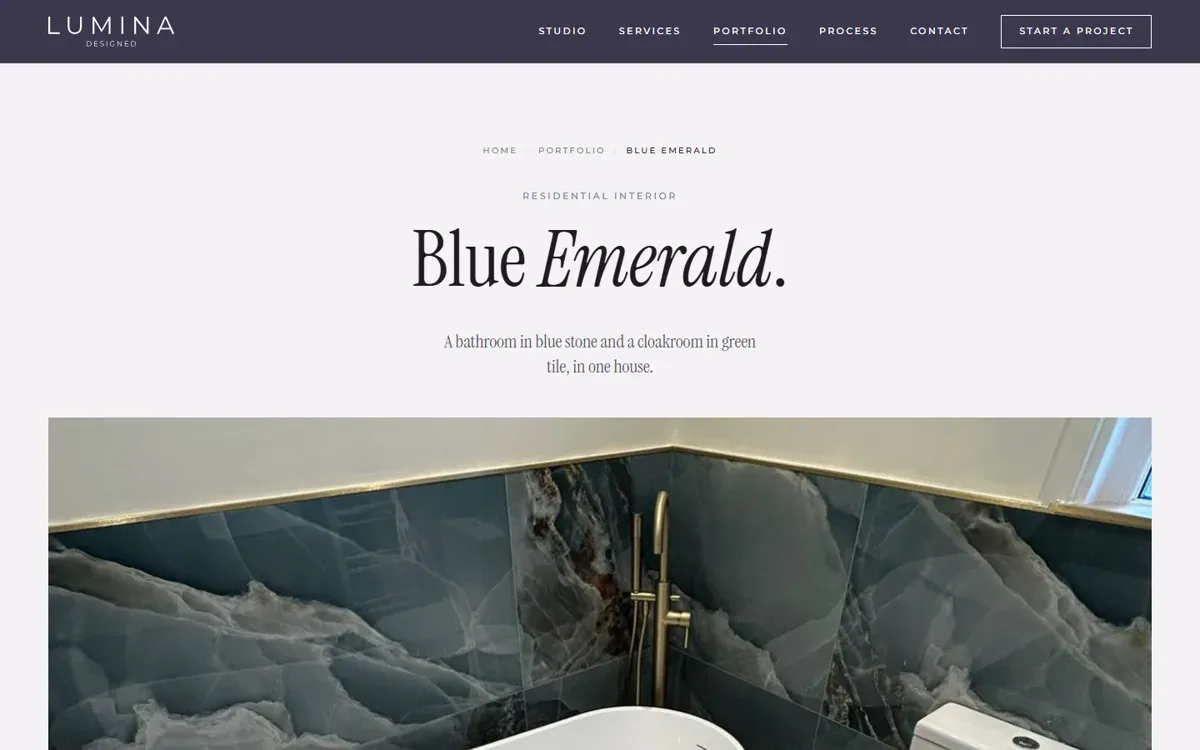
The second is your gallery. A long scroll of photos with no captions helps less than a page per project that says what the job was, where it was and how long it took. The Lumina Designed site we built gives each project its own page in this way, so a customer planning a bathroom can see a finished bathroom and read what went into it.
The third is speed and layout on a phone. Large photos uploaded straight from a camera make a page slow. Buttons too close together get tapped by mistake. Many builders will let you make both mistakes without a warning.
None of this is impossible on a builder. It takes hours to learn and hours to do, and most tradesmen would rather spend them on paid work.
What a web designer gives you
A designer, or a company that builds sites, does the setup for you. They should write or tidy the wording, structure the pages around how customers search, size the photos and handle the domain and hosting.
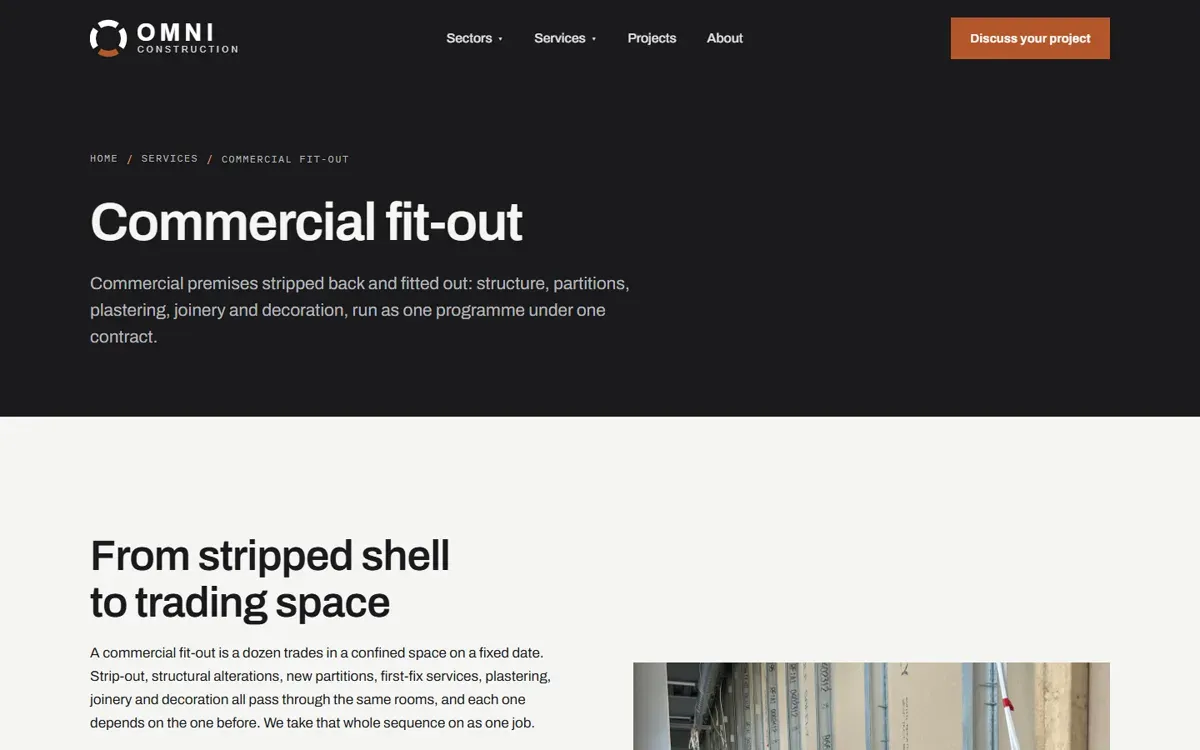
The Omni Construction Group site is an example of that structure. It has a separate page for each service, such as commercial fit-out, and a section for each sector it works in. A customer looking for one kind of job lands on a page about that job.
The trade-offs are real too. A one-off build can cost a lump sum before you see any return. Some designers charge for every small change after launch, and some keep the domain in their own name, which makes leaving awkward. A poor designer can leave you with a site no better than one you could have built yourself.
How to choose
A builder is likely the right call when:
- You are just starting out and money is tight
- You offer one or two services in one town
- You enjoy this kind of work and have regular free evenings
- Most of your work comes by referral and the site only needs to confirm you are real
A designer is likely the better call when:
- You offer several services across several towns and want each to be found
- You want to win bigger jobs where the customer compares firms carefully
- Your current site has not been updated in over a year
- You would rather spend Sunday with your family than on your homepage
A simple test helps. Work out what an hour of your time earns on a job. Multiply it by the hours a builder will take you in the first year, including the first build. Compare that with what a designer would charge for the same year.
Questions to ask either way
Whichever route you pick, check these before you commit:
- Is the domain registered in your name, so you keep it if you leave?
- What happens to the site if you stop paying?
- Who makes changes after launch, how quickly, and at what cost?
- Does the contact form send to an inbox you check, and has someone tested it?
- Have you looked at the finished site on your own phone, outside on mobile data?
Our page on hosting and ongoing support explains what we include for hosting and changes after launch.
How SiteFlash fits in
We sit between the two options. We build and look after websites for UK trade businesses, and you see a working concept of your site before you pay anything. Our two packages start at 149 pounds a month with no upfront cost and no contract, and hosting, your domain and edits are included. If a builder suits you better right now, that is a sensible choice, and the questions above will help you set it up well.