A pay monthly website for tradesmen spreads the cost of a website into a fixed monthly fee instead of one large invoice at the start. For most trade businesses it is a fair deal, as long as you know what the fee covers, who owns the domain and what happens when you stop paying. Those three answers vary between providers more than the price does.
The three ways to get a trade website
Every option comes down to who pays for the build, and who looks after the site once it is live.
- Upfront build. You pay a designer or agency once for the build. Hosting, the domain and later changes are usually billed on top, either as a yearly charge or by the hour.
- Pay monthly. You pay nothing or very little at the start. One monthly fee covers the build, the hosting and an agreed amount of upkeep.
- DIY website builder. You pay a monthly subscription for the tools and build the site yourself, in the evenings, after a day on site.
None of them is right for everyone. A roofer in Doncaster with a van, two lads and a full diary has a different problem from a building firm with an office manager. We compared the build options in more depth in our guide to choosing a website builder or a web designer.
What a pay monthly fee usually includes
The word "website" covers a lot of different packages. Before you compare prices, check that you are comparing the same things. Most pay monthly packages for trades include some of these:
- The design and build of a set number of pages
- Hosting, so the site stays online
- The domain name, registered and renewed for you
- Security certificates and backups
- Edits, such as a new service page or fresh project photos
- Some search work, such as local keywords or a review of how the site ranks
The two lines that differ most are the page limit and the edits. A package of five pages suits a sole trader who does one thing in one town. A firm that does extensions, loft conversions and roofing across several towns needs a page for each of those. That pushes it into a bigger package or an extra charge.
Edits matter more than they look. A site you cannot change goes stale within a year. Your phone number changes, you stop doing a type of job, or you want to show the extension you finished last month. Ask how many edits are included, how you request them and how long they take.
Who owns the domain and the content
This is the question to settle before you sign anything. There are three separate things to own.
The domain is your web address. If a provider registers it in their own name, moving away later can mean asking their permission, or losing the address your vans and business cards point to. Ask whose name the domain is registered in, and whether they will transfer it to you if you leave.
The content is the text, photos and logo. Photos of your own jobs are yours because you took them. Text written for you is less clear-cut, so check the terms say it passes to you.
The design and code are where pay monthly differs most from an upfront build. With an upfront build you usually own the finished site files. With pay monthly the design often stays with the provider, because the monthly fee pays for it over time. That is a fair trade if you know about it. It is a nasty surprise if you find out on the day you leave.
Whoever you choose, get these answers in writing before the first payment. Our own answers to the common questions are in the SiteFlash FAQ.
What happens if you cancel
A pay monthly site normally goes offline when you stop paying. The fee pays for the hosting that keeps it live, so that is how the model works. What you need to know is what you walk away with.
Before you sign, get written answers to these:
- Is there a minimum term, and how long is it?
- Is there an exit fee, or a charge for the rest of the term?
- How much notice do you have to give?
- Will the domain be transferred to you, and is there a fee for that?
- Can you have a copy of your text and photos?
Contract lengths in this market run from rolling monthly to a fixed term of a year or longer. A fixed term is not a bad thing in itself. It can explain a lower monthly price. It becomes a problem when the site is poor and you are tied to it for another eighteen months.
Our own terms are on the SiteFlash pricing page. There is no contract, no minimum term and no exit fee. If you cancel, the site comes offline at the end of the month you have paid for. A domain you already owned stays yours, and the logo, photos and text you gave us are yours to keep.
Working out the real cost
A monthly fee looks small and an upfront quote looks big, so compare them over the same period. Three years is a fair test, since that is roughly how long a trade website runs before it needs a refresh.
For an upfront build, add the build price to three years of hosting, three years of domain renewals and the cost of any changes you expect to ask for. For pay monthly, multiply the monthly fee by 36 and add any setup fee. For a DIY builder, multiply the subscription by 36 and then put a value on your own evenings.
As a worked example, a package at 149 pounds a month comes to 1,788 pounds a year, or 5,364 pounds over three years, with hosting, the domain and edits inside that figure. Put a written upfront quote next to it, with the same three years of hosting and changes added, and you have a fair comparison.
The cheapest option on paper is not always the cheapest in practice. A DIY site that nobody finds, or that looks broken on a phone, costs you the jobs it never brings in.
The site still has to win work
Whichever way you pay, the site has to work on a phone. Ofcom's Online Nation 2025 report found that smartphones accounted for 77% of all time UK adults spent online on an average day in May 2025. A homeowner with a leaking roof is looking at your site on a phone, often on a patchy signal.
Your site is also where people go to check you out after reading your reviews. BrightLocal's Local Consumer Review Survey 2026 found that 54% of consumers check a business's website after reading positive reviews. The survey is of US consumers, though the habit is a familiar one to anyone who has been told "I looked you up first".
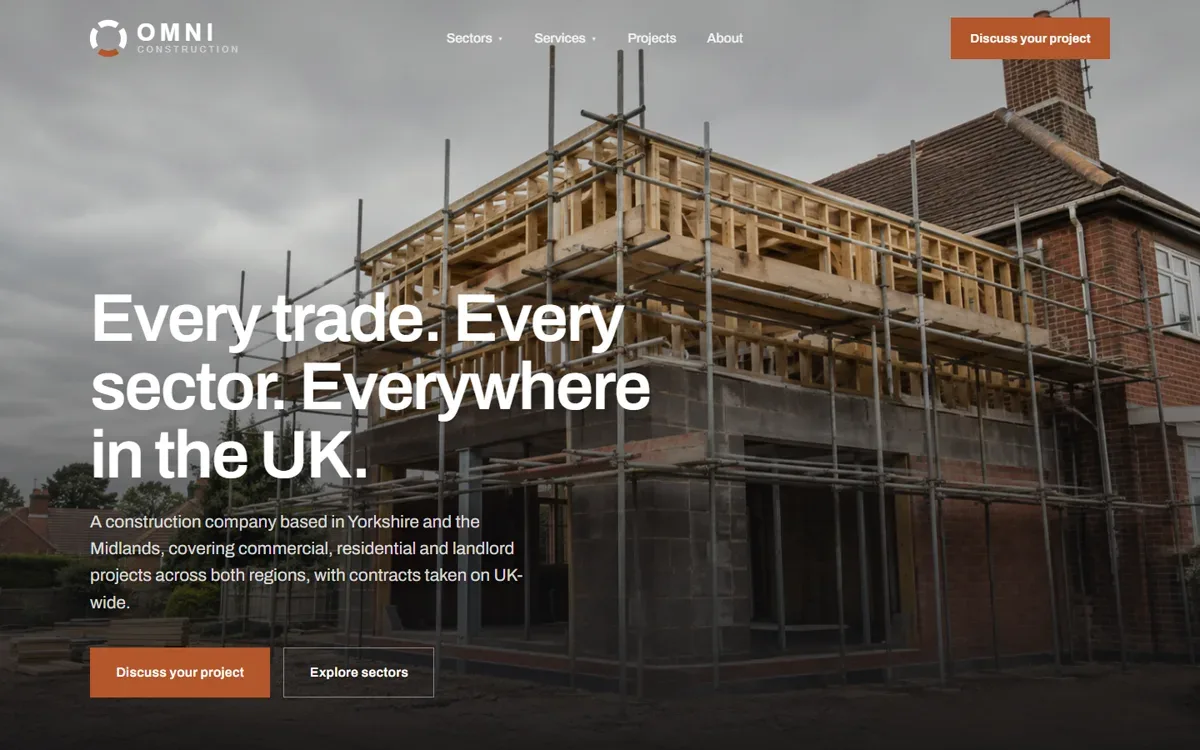
So whatever package you choose, ask to see sites the provider has built for other trades and open them on your own phone. The Omni Construction Group site in the photo above is one of ours. You can read how we put it together, including its sector and service pages, in the Omni Construction Group case study.

When an upfront build is the better choice
Pay monthly is not the answer for every business. An upfront build makes more sense when:
- You have the cash now and would rather not carry a monthly cost for years.
- You want to own the design and code outright and be free to move them to any host.
- Someone in your business can handle hosting, updates and fixes, or you already pay a person who does.
- You need something unusual, such as an online booking system or a shop, which pay monthly packages often quote separately.
DIY can make sense too. A new sole trader with more evenings than money can get a simple page live with a website builder and move to something better once the work picks up.
Pay monthly suits the trade business in the middle. You want a site that looks the part and keeps working, you have no time to look after it, and you would rather keep the cash in the business for materials and wages. The upkeep side of that is what our hosting and support covers.
How SiteFlash does pay monthly
We build websites for UK construction and trade businesses on two monthly packages, set out on our pricing page. The Minimum package is 149 pounds a month for up to six pages. The Growth package is 295 pounds a month for up to twelve pages, with eight local keywords and a quarterly SEO review. Both have no build fee and no contract, and both include hosting, the domain and edits made for you. You see a working homepage for your own business before you pay anything, and you can browse our work to see the standard first.